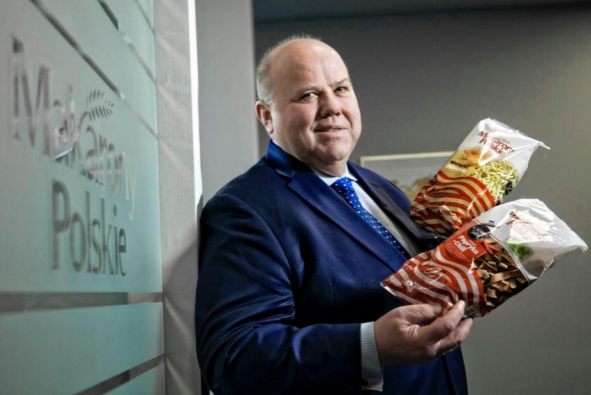
CEO of Makarony Polskie We want, what we did at the investment stage, to bear fruit for us and our customers
14 February 2020
CEO of Makarony Polskie We want, what we did at the investment stage, to bear fruit for us and our customers
The most important assumptions for 2019 were the investment projects. During this period, we implemented 4 projects with a total value of PLN 50 million – says Zenon Daniłowski. In an interview with portalspozywczy.pl, the CEO of Makarony Polskie talks, among others about barriers in the food sector that the industry has to deal with, brand development in the Group's portfolio, export activities and private label. And above all, he presents development plans and strategy for individual brands in the Group for 2020.
What was the past year for the Makarony Polskie Group?
2019 was a good year for our Group as well as for the entire pasta industry, because the demand for our products was high due to the greater amount of money in the hands of consumers and the growing demand for plant-based diet products. For 2019, Makarony Polskie had planned sales of approx. PLN 170 m, with a 4% net margin. I can say that after the Q3 the plan was fully implemented and the fourth quarter in my opinion was also good and I think it will be a successful year in terms of the results of Makarony Polskie.
Which of the challenges for 2019 have been met?
The most important assumptions for 2019 were the investment projects. During this period, we implemented 4 projects with a total value of PLN 50 m. Two of them in Rzeszow, the first of which is the production of high-protein pasta, and the second one is the production of pasta from flour which does not contain gluten such as buckwheat or corn flours. It is worth noting that those pastas are growing in popularity among consumers, because they have, in addition to their interesting taste, special nutritional and even health-promoting values.
The other two investments were implemented at the production plant in Stoczek Łukowski. One of them is the modernization of the production line of ready meals in cans and jars. And the second one is a new line which we purchased for the production of ready meals on trays. This meal is very convenient to eat, because you can reheat it in an oven or microwave in 3-5 minutes. The first dinners from Stoczek will be soon available for purchase. It is an offer for singles, as well as for people living “in a hurry” which is so common nowadays.
We have already completed two of those investments – one in Rzeszow and the other one in Stoczek. The other two projects are at the stage of commissioning, and in the first half of 2020 they will be ready for industrial exploitation.
And what surprised you about the food industry last year? With the industry had to face?
Two significant barriers appeared on the market last year. The first one was the lack of workforce. it is difficult to find both manual and technical workers. This is the main barrier in the company's development. We have started an intensive project to improve working conditions in our plants. We invest in robotization, change air conditioning and ventilation systems, and expand social facilities. Moreover, we prepare loyalty programs for company employees. We want to employ more employees who plan their careers within the company, for a long time.
Another issue is the strong pressure on the level of wages, mainly caused by the government's announcement of increases in the minimum wage, which raises expectations for increases in all professional groups. Therefore, some employees do not associate the level of pay with the quality and quantity of products manufactured. Breaking the link between creating added value for the plant and increases is very harmful in the long run. This is a problem for all entrepreneurs, because we do not make pay increases in line with the increase in work efficiency, and we give pay increases under pressure of government announcements. In the long run, such activities can be dangerous, because it will deteriorate our competitiveness on global markets, as well as in Poland.
The other barrier is production costs, which are unpredictable and unstable. In 2019, as well as in 2020, energy costs increased. In addition, there were increases in raw material prices, e.g. due to the situation in China and ASF. Ready meals contain a large amount of meat, so Stoczek strongly feels increases in meat prices.
You said about the negative aspects, but can you indicate the positive phenomena of the industry?
We have very high demand on the market. Christmas was a great harvest for producers, even pasta, which is non a Christmas product, was selling very well during this period. In Q4, we had a problem keeping up with orders, because there were a lot of promotions and in-outs. And this is a positive aspect of 2019. Added to this is the transition of consumers from cheap products to better, tastier, better packed, healthier and better quality products. Today it has become a fact what we only talked about 2-3 years ago, i.e. the clean label trend. Today, the consumer is very conscious. Currently, food not only satisfies hunger, but heals and positively affects our body. We buy less mass products and more better quality in a richer selection. We eat with all our senses. For the modern consumer, not only taste is important, but also where the raw materials come from, who made the products.
In response to the changing approach of consumers to food, a new brand appeared on the market last year – Novelle. How do you assess this action? What are the further development plans for this brand?
Novelle is one of the brands responsible for the environment. We are part of a stream based on a plant diet. This is the answer to current food trends. We produce pasta, among others from chickpeas, lentils and green peas, or wholegrain, buckwheat and spelt pasta And our offer will be expanded to include other products, e.g. vegetable pastes. Novelle pasta are sublime products, dedicated to people who care about their physical condition. We are currently at the stage of building a portfolio, sales system and informing consumers about our products in social media. An important trend on the market is the development of a vegetarian offer. Within ready meals on trays of the So Food brand, we introduce 4 meatless dishes, e.g. Wegab with paprika and rice. They are very tasty, they will not differ in price from traditional dishes and will definitely be appreciated by vegetarians. But the road to success is long and requires constant monitoring and keeping up with consumer preferences.
Coming back to the main brands of the Group. In 2019, in terms of the Makarony Polskie and Stoczek brands, you said that you want to get closer to being a leader in your segments. What is the current position of the brands in each category?
We want to be a B brand and be on the podium steps. Our Makarony Polskie brand products have loyal consumers. It is a product made of a special blend of domestic wheat, enriched with hard wheat flour, because this taste and texture are preferred by Polish consumers. Within the Makarony Polskie brand, we also develop tagliatelle and strip pasta lines with the addition of eggs. They are tasty and after cooking they go very well with sauces or as an addition to soups (especially to broth). Year-on-year sales of our pasta increased by PLN 1 m, and I hope that 2021 will be much better.
On the other hand, when it comes to Stoczek, this is a general problem for producers of ready meals in jars and cans, because the group of recipients of this type of products is shrinking. They are usually people detached from the family, such as builders or drivers. And in the circles of people who lead a sedentary lifestyle, this type of ready meals are not very popular. Therefore, as I have already mentioned, we will go into the development of So food, i.e. ready meals on trays. It will be a full dinner preserved by a thermal processing, without chemical additives, closed using a technique similar to pasteurization. You can quickly prepare such a dinner. There will be three types of dinners to choose from. Cuisines of the world: Indian, Lebanese, Mexican ones. The second type is veg and the third one: the Polish cuisine. There will be 8 dishes, some of which are already available, and more will appear in February. This will cause, for example, that some of the previous meals in jars will be transferred to trays. In Stoczek Natura's development strategy, we will focus on modern products, because market analysis shows that consumers are looking for convenience products that are ready to eat.
Makarony Polskie also sells private labels to the network. How do you assess these activities?
Maintaining the leading position when it comes to private labels in pasta production was the main challenge of last year. In my opinion, our position is very strong and we provide more and more products to the discount stores network. Together with the networks, we develop products within NPD. Our company works closely with discount stores in the development and preparation of the ingredients.
However, the big challenge was to increase the number of high-quality products in our offer, because currently private label is not an economic product, but it is often a premium product and we meet such challenges. Both parties have experience and conduct market research. An increasingly wider partnership is emerging and this has changed in recent years in the relationship between the network and the producer.
It is important to note the fact that network brands are becoming stronger than producer brands. I am not talking only about pasta, but about many other products. Through their sales strength, the networks have promoted their private label products which gained the brand rank And they have a very strong market position today. These are high quality products. We can no longer say that private label is an economic product, because most of them are medium and top shelf. Therefore, the products we manufacture as a private label are high quality products, because such are the market expectations. Once a private label competed in price, and today it competes in quality.
And how do the export activities of Makarony Polskie look like?
Markets distant from Europe have two disadvantages. Firstly, logistics for volumetric products, such as pasta, is expensive; and secondly there is very high price competition from producers from the Mediterranean basin, e.g. Turkey. Therefore, our sales to Asia and Africa are growing very slowly. We sold premium products there in 2019, but these are small quantities that are mainly to maintain relationships with our traditional partners.
We currently export over 10% production mainly to neighboring countries such as Belarus, Lithuania, Ukraine, Slovakia, or nearby countries Serbia or Romania. Sales in these countries are financially attractive to us. It is worth adding that sales are going well in those markets where we have a strong local partner. Entering the market without a local partner, without knowing the tastes and needs of local consumers is “throwing money down the drain”. We have done a good job researching those markets, getting to know the tastes of local consumers, and therefore we are successful in them. However, in other markets we did not succeed. Each country has its own character and you have to adapt to it. Speaking of exports, I am still counting on opening of the Russian market, which is now an opportunity for Polish agri-food processing. We need this market.
Improving relations between the EU and Russia may break mental barriers. In business, prejudice and stereotypes often influence purchasing decisions.
What will Makarony Polskie Group focus on this year?
The main challenge of 2020 is to master the new technologies purchased and developed at our plants. Bringing them to full performance, not only in terms of quantity but also in quality terms. We also want to offer consumers competitive, more diverse products based on vegetable raw materials. This is our main goal – we want, what we did at the investment stage, to bear fruit for us and our customers.